
US President Donald Trump has indefinitely extended the ceasefire with Iran at the request of Pakistan, aiming to allow Tehran's leadership time to form a unified proposal to end the seven-week war.

Iran has denied agreeing to participate in a second round of peace talks, contradicting claims made by the United States. The denial comes as tensions remain high in West Asia, with a ceasefire window nearing its end.

Chinese President Xi Jinping has called for the Strait of Hormuz to remain open for normal passage of ships, describing it as an 'international waterway' amid rising tensions between the US and Iran.

Iran's Foreign Minister Seyed Abbas Araghchi on Sunday issued a formal address and said that the event is a moment of profound religious and historical consequence.

Uncertainty surrounds the planned second round of peace talks between the US and Iran in Islamabad, as both sides engage in brinkmanship. Despite Pakistan's security preparations, Iran has yet to confirm its attendance, citing a lack of seriousness from the US in pursuing diplomacy and violations of the ceasefire.

Despite a ceasefire extension, Iran has rejected the United States' conditions for negotiations, creating uncertainty in ongoing diplomatic efforts.

The clock on the ceasefire is running out. But everyone's already whispering about round two, possibly as soon as this weekend.

Chinese President Xi Jinping warned US President Donald Trump that mishandling the Taiwan issue could trigger conflicts between the two countries during wide-ranging talks on trade, Iran, and energy security.

As the negotiations continued, the Iranian government said on social media that "talks between Iran and the US in Islamabad entered the expert-level stage as economic, military, legal, and nuclear committees joined in".

The Congress party has criticised the Modi government over Pakistan's involvement in US-Iran peace talks, calling it a 'monumental setback' for India's diplomatic efforts.

A Financial Times report reveals Pakistan's crucial role in brokering a temporary ceasefire between the US and Iran, driven by White House concerns over rising oil prices and Iran's resilience.

National Security Advisor Ajit Doval met UAE President Mohamed bin Zayed Al Nahyan to discuss deepening strategic partnerships and the regional situation, following meetings with Saudi Arabian leaders earlier in April.

Mojtaba Khamenei, son of Iran's Supreme Leader, is reportedly recovering from injuries sustained in an attack. Reports indicate he is participating in meetings and decision-making despite his condition.
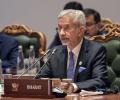
India has expressed serious concerns about the West Asia crisis and its potential impact on energy supplies and maritime stability, urging BRICS nations to find practical solutions to geopolitical challenges and unilateral sanctions.

US Vice President J D Vance stated that while progress was made during peace talks in Islamabad, it is now up to Iran to further the discussions and address US concerns regarding its nuclear ambitions.

Iran has announced the Strait of Hormuz is open to commercial vessels, coinciding with a ceasefire between Lebanon and Israel.

The central headquarters of the Iranian armed forces has issued a stark warning to the United States and its regional partners following recent threats made by President Donald Trump, state broadcaster Press TV reported.

Iran's representative in India, Abdul Majeed Hakeem Ilahi, describes the ongoing tensions between Iran and the US-Israel alliance as a state of 'no war, no peace,' calling for an immediate halt to the conflict and questioning the lack of pressure on the US and Israel to cease aggression.

US Vice President JD Vance's visit to Islamabad for peace talks with Iran has been put on hold after Tehran failed to respond to American negotiating positions, according to a New York Times report.

US President Donald Trump on Monday doubled down on his hardline stance against Tehran while dismissing mainstream media narratives regarding his foreign policy motivations.

Former Central Command chief David H Petraeus suggests the US and Iran are likely to extend their ceasefire beyond the initial two-week period, citing willingness from both sides to continue negotiations.

If Trump doesn't like India, that is his choice. But to use such distasteful language on a public platform is deeply offensive and needs to be called out, points out Amberish K Diwanji.

US President Donald Trump on Sunday announced that the American Navy will henceforth block all maritime traffic entering the Strait of Hormuz.

Iran has confirmed its participation in peace talks hosted by Pakistan, aimed at resolving the conflict with the US and Israel, despite concerns over ceasefire violations.

Italy rejects a proposal by Trump envoy Paolo Zampolli to replace Iran at the FIFA World Cup 2026, as officials insist qualification must be earned on merit.

Iran has not closed the Strait. It remains open; however, due to current conditions and circumstances, ships are unable to pass through the Hormuz. Otherwise, Iran never wanted the Strait to be closed or blocked, the supreme leader's representative said.

Pakistan has intensified its efforts to bring the US and Iran back to the negotiating table to end the war in West Asia, following President Trump's extension of the ceasefire. Pakistani officials have engaged with Iranian, Turkish, and British counterparts to promote dialogue and diplomacy for a peaceful resolution.

Donald Trump has expressed confidence that Tehran will engage in diplomatic talks, warning that the country will 'see problems' should it refuse to cooperate.
Russian Foreign Minister Sergei Lavrov will visit Beijing to discuss the West Asia conflict, the Strait of Hormuz blockade, and bilateral relations with Chinese leaders.

Explore the resilient daily life in Tehran, where residents navigate geopolitical tensions and economic challenges with routine activities, showcasing a striking contrast between normalcy and underlying uncertainty.

US President Donald Trump threatened to bomb Iran if a deal is not reached before the ceasefire ends, while Pakistan urged both sides to extend the truce and pursue diplomacy.

The Indian rupee weakened against the US dollar due to a strengthening dollar, high crude oil prices, and foreign fund outflows amid geopolitical uncertainties.

Citizens in the city of Ilam formed a human chain on Tuesday to demonstrate their defiance against recent threats from US President Donald Trump.

Trump seems to have estimated that Ghalibaf is a pragmatic politician who is receptive to close relations with the US and is enthusiastic about fostering business and economic ties in particular, points out Ambassador M K Bhadrakumar.
Trump has made it clear: the US will not lift its blockade of Iranian ports until a deal is signed.

Joe Kent, former head of the National Counterterrorism Center, accuses Israel of instigating the conflict between the United States and Iran, claiming there was no imminent threat from Iran.

For that to happen America does not have to lose. It only has to do the right thing, asserts Aakar Patel.
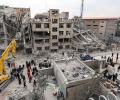
The call came before Iran's new supreme leader Mojtaba Khamenei vowed vengeance and urged citizens to continue their fight against the attacks by US and Israel.

US President Donald Trump is set to provide an "operational update" on the progress of 'Operation Epic Fury' during a national address scheduled for 9 PM Wednesday (US local time).

'In such a scenario, Iran could proclaim itself victor, rebuild, re-enforce its diminished regional proxies to further destabilise neighbouring nations and take control of the Persian Gulf and Strait of Hormuz.'
 © 2026 Rediff.com - Advertise with us - Disclaimer - Privacy Policy - Sitemap - Feedback - About us - Terms of use - Grievances